
Words that moved
Thomas calls a man reprobate, and means he failed at the assay, as silver does. Teresa writes of mansions, which are resting places on a road. A reader who supplies the modern sense gets a harsher book than the one that was written.
A five-volume collection
Five works of Catholic spirituality, complete and unaltered, with explanations set next to the text at the points where a modern reader is likely to be stopped. The author’s page stays the author’s page.
The difficulty
The sentences are usually plain. What defeats people is everything the text assumes and never stops to explain: a vocabulary that has shifted, a religious life nobody now leads, an argument whose grounds lie three centuries away.
Thomas calls a man reprobate, and means he failed at the assay, as silver does. Teresa writes of mansions, which are resting places on a road. A reader who supplies the modern sense gets a harsher book than the one that was written.
Augustine argues against the Manichees for four books without ever explaining who they were. Ignatius writes to a retreat director, not to you. The missing half of the conversation is what makes the surviving half look strange.
John of the Cross gives three careful signs for recognising the dark night. The phrase escaped the book long ago, and now readers apply it to grief, exhaustion and depression — which is the one use he ruled out.
How the pages work
You can tell them apart before you read a word. The rule holds on every page of all five volumes.
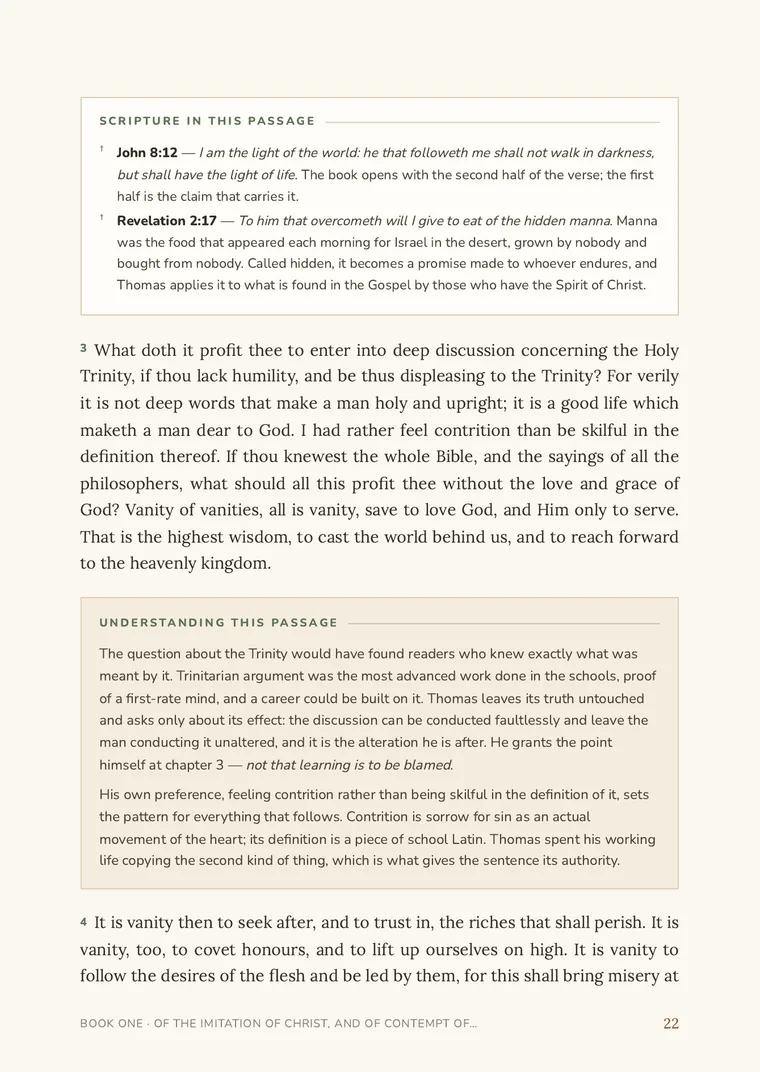
What doth it profit thee to enter into deep discussion concerning the Holy Trinity, if thou lack humility, and be thus displeasing to the Trinity?
Benham’s note: the chapter’s scripture references, given at the foot of the chapter as he printed them.
Trinitarian argument was the most advanced work done in the schools, proof of a first-rate mind, and a career could be built on it. Thomas leaves its truth untouched and asks only about its effect.
Set in serif, the page is his
The historical translation is reproduced entire, without alteration. Older spelling stands. Older verb forms stand. Nothing is modernised, smoothed, shortened or silently improved.
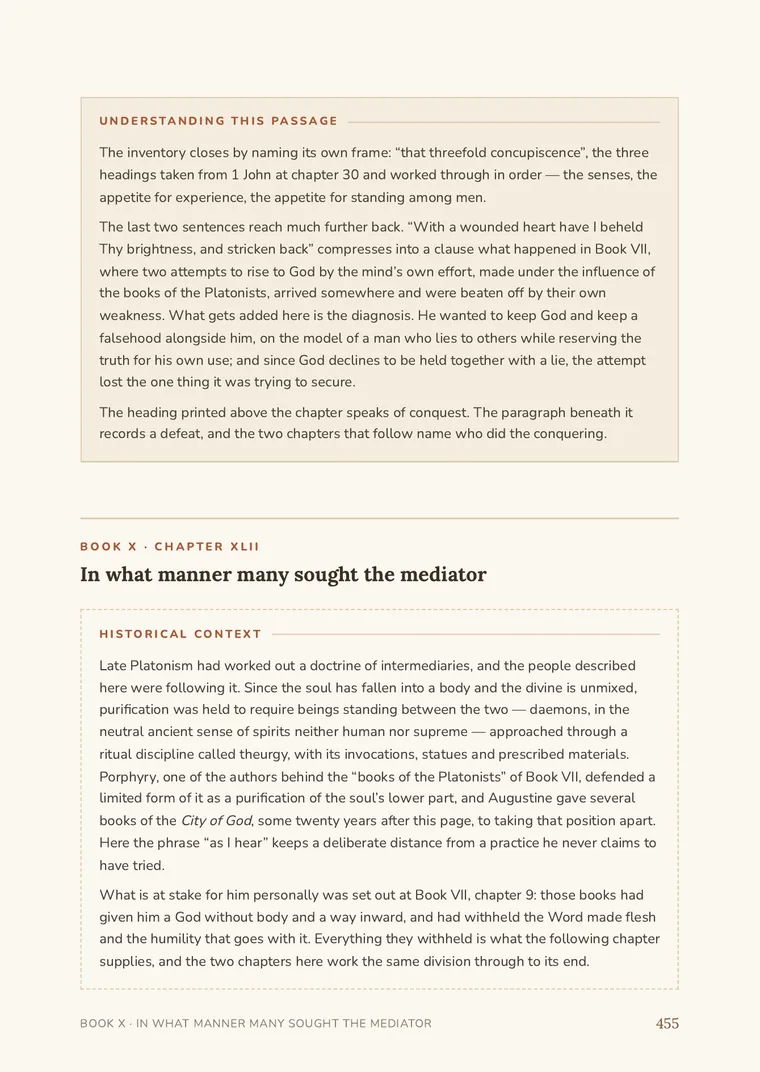
Everything this edition adds sits in a tinted panel, in a different typeface, at the point where it helps. A panel appears because a passage is genuinely difficult — never to fill a page. Whole chapters go by without one.
A third voice, smaller and ruled at the left, belongs to the nineteenth-century translator or reviser: his footnotes, his chapter digests. It is neither the saint nor us, and it is never dressed as either.
Before you spend anything
Said plainly, including the part where the answer is no.
Inside the pages
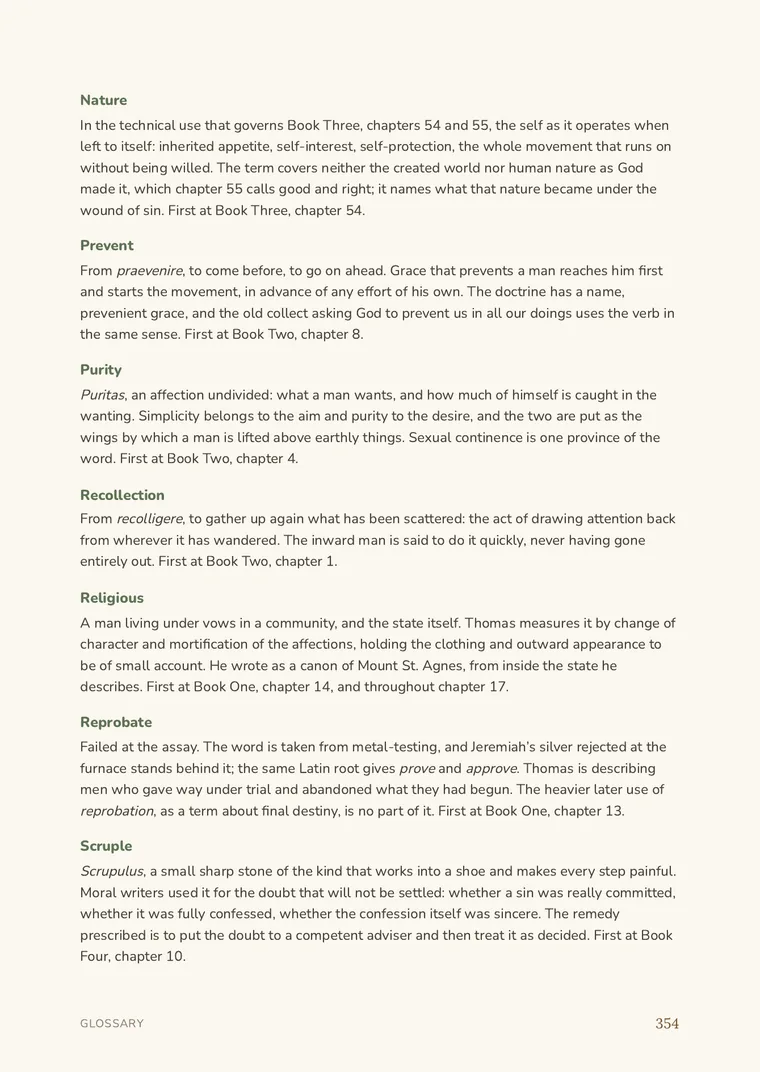
Not mock-ups. These are pages from the typeset volumes, exactly as they print.
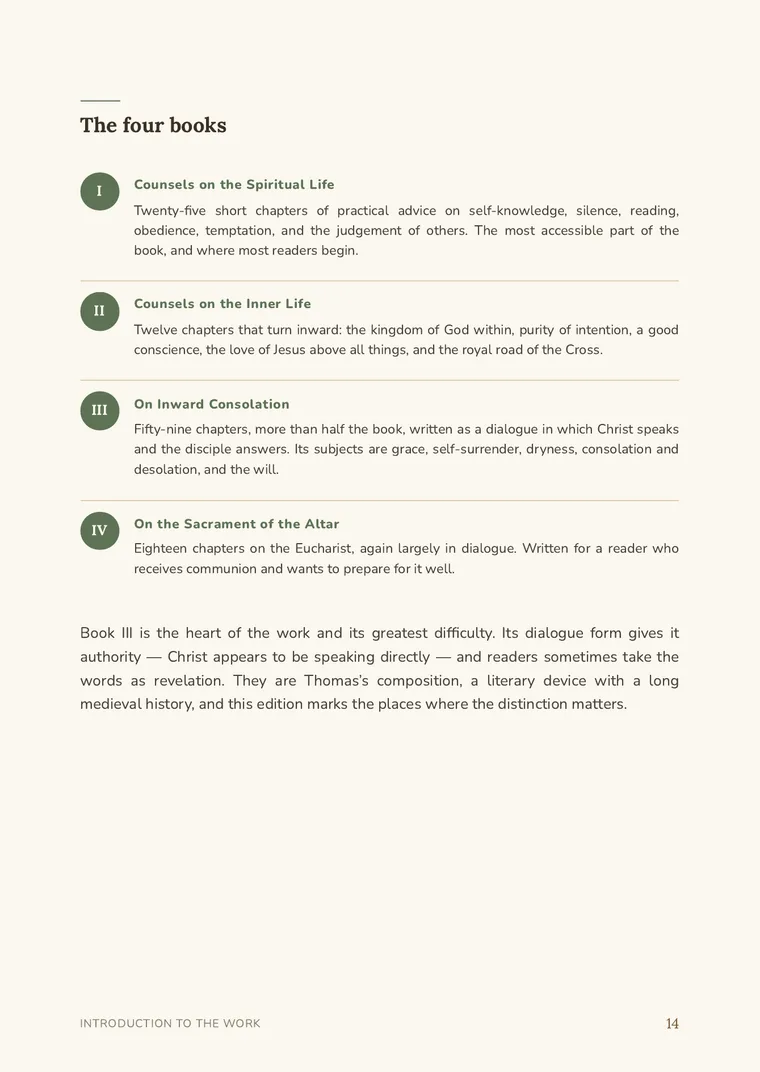
Before the text begins
A note on the edition, a guide to reading it, an introduction to the author and the work, and a map of where the argument goes. At the back: a summary and study questions for each part, a glossary, and a thematic index for following one subject through the whole book.
Why you can trust the text
An edition that promises the complete text owes you an account of how it knows the text is complete. Here is ours.
The digital sources of these translations disagree with one another more often than you would expect. Each volume was verified sample by sample against an independent copy of the same translation: 342 passages in the Imitation, 828 in the Confessions.
The Imitation came back with zero divergences. The Confessions came back with three — one a page-break artefact, two genuine typographic errors in one of the sources, both corrected. Which reading was adopted, and why, is recorded.
The chapter sequence of each work was verified against the division the work has carried for centuries: 114 chapters in the Imitation across four books, 276 in the Confessions across thirteen, 27 in the seven mansions of the Interior Castle, 39 in the two books of the Dark Night.
One source had lost six chapter headings and all four book divisions in digitisation. That was found, and repaired from a complete copy of the same translation.
Every scripture reference in every panel was checked for book, chapter and verse. These authors quote the Vulgate, where the psalms are numbered differently from most modern Bibles, and the difference is marked wherever it matters.
A reference that could not be confirmed was removed rather than guessed at. The same rule governs the thematic index: each entry was opened and read before it was printed.
Every panel passed a second reading whose brief was to remove rather than to approve. A panel that only restated the passage in modern words, or that had no clear function, was cut — because an explanation that explains nothing costs the reader attention and gives back nothing.
Whole chapters go by with no panel at all. That is the system working, not the system failing.
Each volume names its exact source edition on its credits page, including the ones where two printings of the same translation differ, and says which was followed.
Choosing where to begin
Each complete in itself. They were written by authors who mostly never read one another, so there is no required order — but there is a sensible one.
If you are choosing one, choose the Imitation. Not because it is the best of the five, but because its chapters are two or three pages long, it assumes no background, and it is the only one of the five that can be read a chapter a day without losing the thread. Readers who begin elsewhere and stop usually began with the Confessions, whose last four books defeat people.
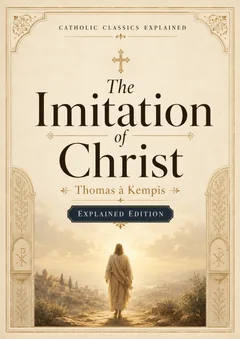
Thomas à Kempis · Four books · 114 chapters
Choose this one when you want the most approachable of the five, in chapters of two or three pages that can be read one a day.
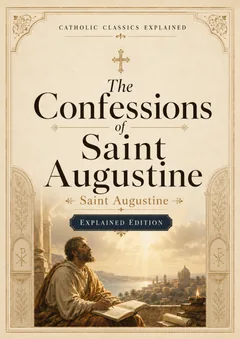
Saint Augustine of Hippo · Thirteen books · 276 chapters
Choose this one when you want a life story that turns into an argument about memory, time and desire — and you are willing to follow it there.
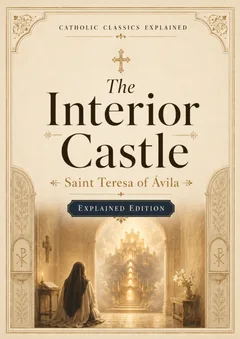
Saint Teresa of Ávila · Seven mansions · 27 chapters
Choose this one when your question is about prayer itself: what changes in it, what is given rather than achieved, and how to tell the difference.
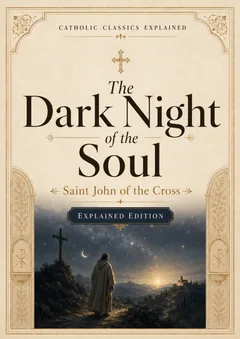
Saint John of the Cross · A poem and two books · 39 chapters
Choose this one when prayer has gone flat and you want to know what the tradition says about that — carefully, and with the distinctions the phrase has lost.
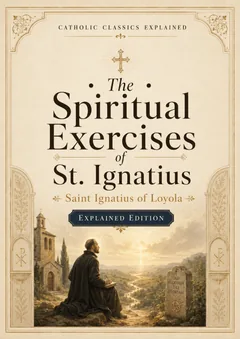
Saint Ignatius of Loyola · Four weeks, methods and rules · 110 sections
Choose this one when you want a structured method rather than a book to read through — examens, meditations, and rules for discernment you can consult.
The complete collection
The five works were written across five centuries by authors who mostly never read one another. What they share is a reader’s problem, and this collection solves it the same way in every volume.
566 chapters · 304,000 words of original text · five centuries of Catholic spirituality
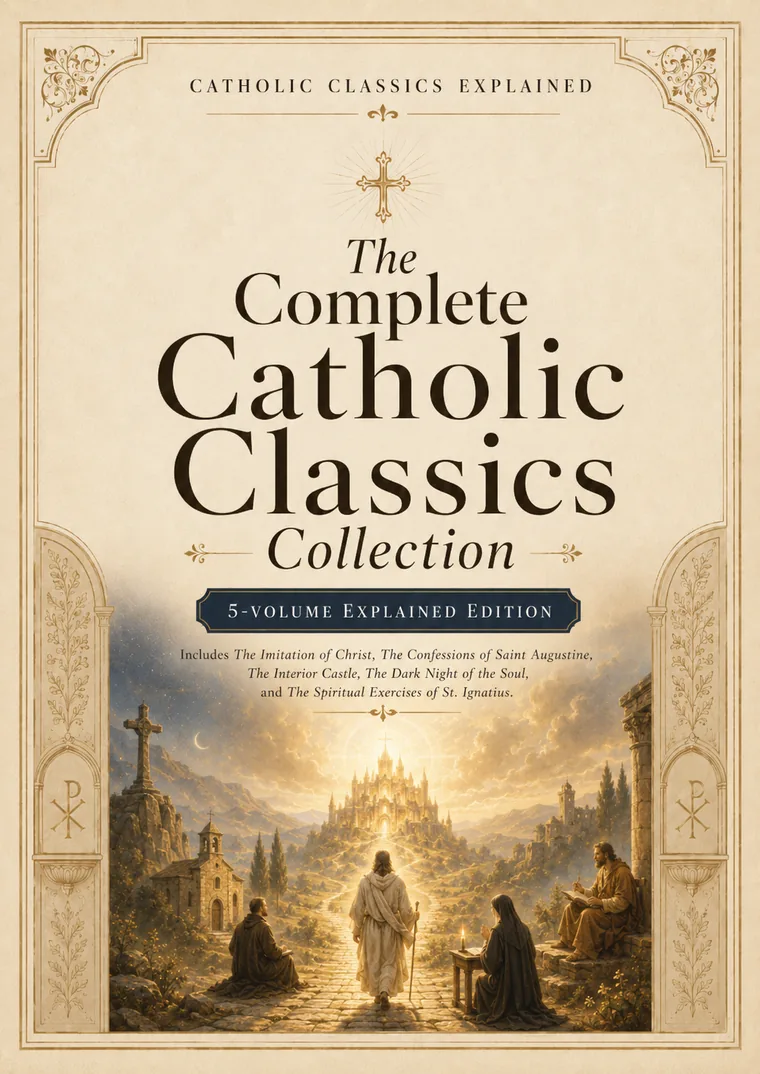
One payment for all five. Yours to keep.
Prefer one book first? Each volume stands on its own at $27.
The soul of the just man is but a paradise, in which, God tells us, He takes His delight.Teresa of Ávila · The Interior Castle, First Mansions
Questions
Entirely. Every chapter of every work, in the historical translation, without cuts, summaries or rewording. The Imitation gives all four books and all 114 chapters; the Confessions all thirteen books and 276 chapters. Where two digital sources of the same translation disagreed, the reading was settled against a second witness and the decision recorded.
No, and the design exists to make that impossible. The author’s text is serif and occupies the page. Our explanations are sans-serif and sit inside a tinted panel. The historical translator’s notes are a third, smaller serif with a rule at the left. The distinction holds on every page, and the credits page states it plainly.
About three panels for a chapter of average length, and only where a passage is genuinely difficult. Short, transparent chapters get one or none. A panel that merely repeated the passage in modern words would waste the page, so those were removed during review.
William Benham for the Imitation, E. B. Pusey for the Confessions, the Benedictines of Stanbrook revised by Benedict Zimmerman for the Interior Castle, David Lewis for the Dark Night, and Elder Mullan for the Spiritual Exercises. They are the standard English versions, all in the public domain, and each volume names its exact source edition.
These are Catholic works and the explanations treat them as such, from inside the tradition that produced them. Where an author states a private conviction rather than the settled teaching of the Church, the difference is pointed out rather than smoothed over. No knowledge of Catholic doctrine is assumed.
No. The five are independent, written across five centuries by authors who mostly did not read one another. If you are choosing one, the Imitation is the easiest place to begin: short chapters, no assumed background. The Confessions is the most familiar name, but its last four books are where most readers stop.
A PDF for each volume you buy, downloadable immediately after payment. The page is 170 × 240 mm — a book proportion rather than a letter sheet — with a clickable table of contents and working internal links. It reads well on a tablet, on a laptop, and printed. On a phone it is legible but tight; these are 300-to-660-page books with generous margins, and a phone screen fights that.
Possibly not in one run, and the editions are built on that assumption. Chapters are short and self-contained, each part closes with a summary and questions, and the thematic index lets you follow one subject — humility, prayer, consolation — across the whole book without reading it front to back. The Imitation in particular was written to be read a chapter a day; four months at that pace covers all 114.
No. The panels exist precisely because the texts assume a vocabulary and a way of life that few readers now have. Terms are defined in the sense the author gives them, religious practices are placed in their period, and where an author states a private conviction rather than the settled teaching of the Church, the difference is pointed out.
Read the cautions in that volume before the text. John of the Cross describes a spiritual process with signs he sets out precisely, and the phrase has since escaped the book to name any difficult period. That volume states clearly and more than once that depression, anxiety, grief and exhaustion are something else, that they ask for proper care, and that reading a classic is not a substitute for it. If you are unwell, that is the honest answer rather than a sale.
All five are finished and typeset — 1,861 pages between them. Each stands on its own, so there is no wrong place to start.